 How-to
Preventing Water Damage From Gutters on Your Home
Last Updated: October 30, 2026
Quick Summary
Preventing water damage from gutters means keeping channels, end stops and downpipes clear so roof runoff leaves fast instead of soaking the fascia, walls and foundation. Clean regularly, flush downpipes, fix sagging runs and failed joins, and extend outlets so water lands well clear of the footing.
- Blocked gutters back water under the roof edge, soaking fascia boards and finding gaps into the wall cavity.
- A four-part seasonal schedule covers summer debris clearing, autumn full cleans, winter leak checks and spring recleaning.
- Sagging channels usually mean loose or failed hangers, or a run that has lost its fall.
- Gutter guards reduce cleaning frequency but do not fix slope, capacity or downpipe problems, or seal a leaking joint.
- Extend downpipes so water lands well clear of the footing and direct flow onto a graded surface.
Table of Contents
- How Gutters Protect Your Home From Water Damage
- How Often to Clean Gutters in the Riverina
- Cleaning Gutters and Downpipes Step by Step
- Signs of Gutter Water Damage to Look For
- Do Gutter Guards Prevent Water Damage?
- Downpipe Drainage and Keeping Water Away From the Foundation
- Frequently Asked Questions
How Gutters Protect Your Home From Water Damage
Preventing water damage from gutters starts with understanding the system: channels, end stops and downpipes that collect roof runoff and channel it away from the roof edge, fascia and foundation. When it works, rainwater leaves fast; when it fails, water goes into your walls and soil instead.
Gutters are often ignored until something sags or a ceiling stains, and by then the damage is done.
What Happens When Rainwater Has Nowhere to Go
Blocked gutters turn a downpour into a slow-motion problem. Water backs up under the roof edge, soaks the fascia board, and finds the first gap into the wall cavity, hitting the same spot for hours.
Here is where the damage usually lands:
- Timber rot in fascia boards and eaves, which is expensive to replace
- Water pooling against the foundation, leading to movement and cracking
- Erosion of soil beds and garden edges below the roofline
The CSIRO's guidance on building moisture and condensation is clear that trapped moisture is one of the main drivers of structural decay in homes. Gutters are the first line of defence against it.
How Often to Clean Gutters in the Riverina
Many homes benefit from gutters being cleaned regularly, with more frequent cleaning where large trees or farmland are nearby. Frequency depends on what falls on your roof, not the calendar, Riverina red dust, dry leaves and wind-blown debris settle fast.
Leaving a long gap between cleans allows debris to compact, hold moisture, and turn a light job into a repair.
A Seasonal Maintenance Schedule That Works
A simple four-part schedule keeps most properties ahead of trouble. Adjust the timing to your tree cover.
| Season | Main Risk | What to Do |
|---|---|---|
| Summer | Dust, dry leaves, bushfire fuel load | Clear debris, check flow, remove leaf litter from roof valleys |
| Autumn | Falling leaves | Full clean of gutters and downpipes, flush lines |
| Winter | Heavy rain, overflow | Inspect for leaks, confirm downpipes discharge clear of the foundation |
| Spring | Pollen, seed pods, nesting material | Reclean, check gutter guards, test water flow |
On a rural block with windbreaks or orchards, a mid-season check is worth considering.
Cleaning Gutters and Downpipes Step by Step
Work from the highest point and let gravity help. Never start at the downpipe end, or you will push debris into the outlet.
Removing Leaves, Debris and Sediment
- Set up safely: firm ground, a stable ladder, and a spotter if you can.
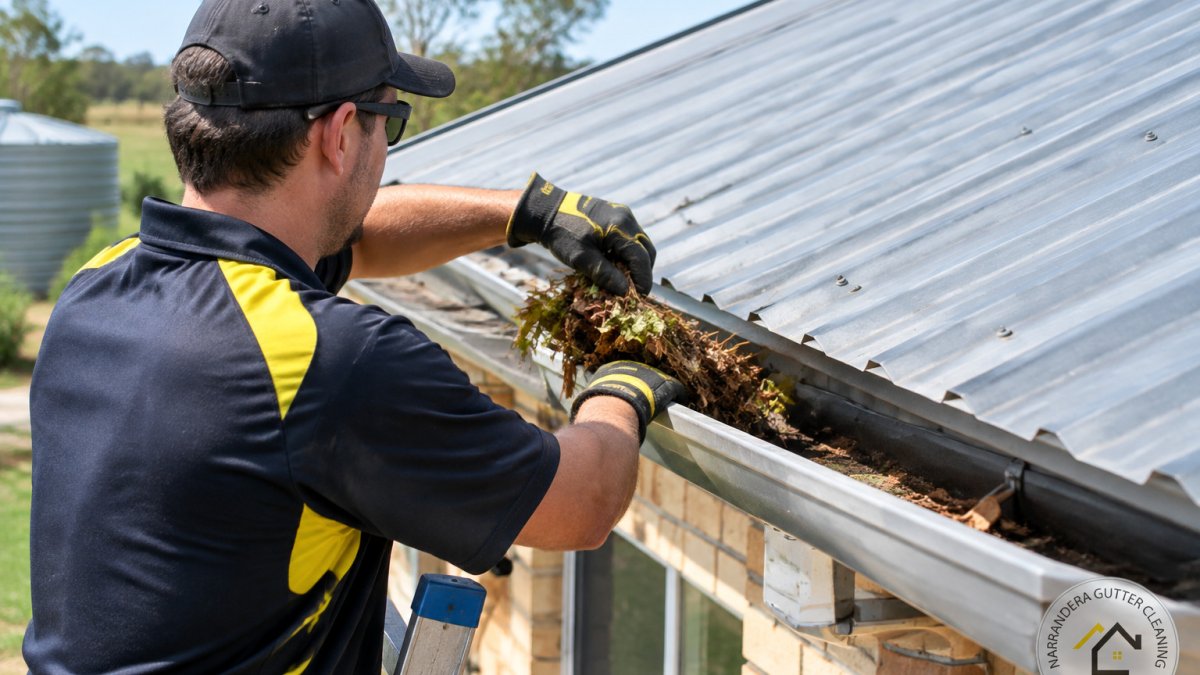
- Scoop out large debris by hand with gloves on.
- Work toward each downpipe outlet, not away from it.
- Bag the waste as you go.
- Scrape out compacted sediment with a small trowel.
Sediment is easy to overlook, and it can build up over time and narrow the system.
Flushing With a Garden Hose and Checking Water Flow
- Run a garden hose from the high end of each run.
- Watch the water reach the outlet without pooling.
- Flush each downpipe from the top.
- Check the outlet: water should discharge freely, not trickle.
- Note any section where water sits, that points to a low spot or blockage.
If a downpipe will not clear, the clog is usually at a bend or the base. Do not force it with a rod until you have checked the bottom outlet.
Signs of Gutter Water Damage to Look For
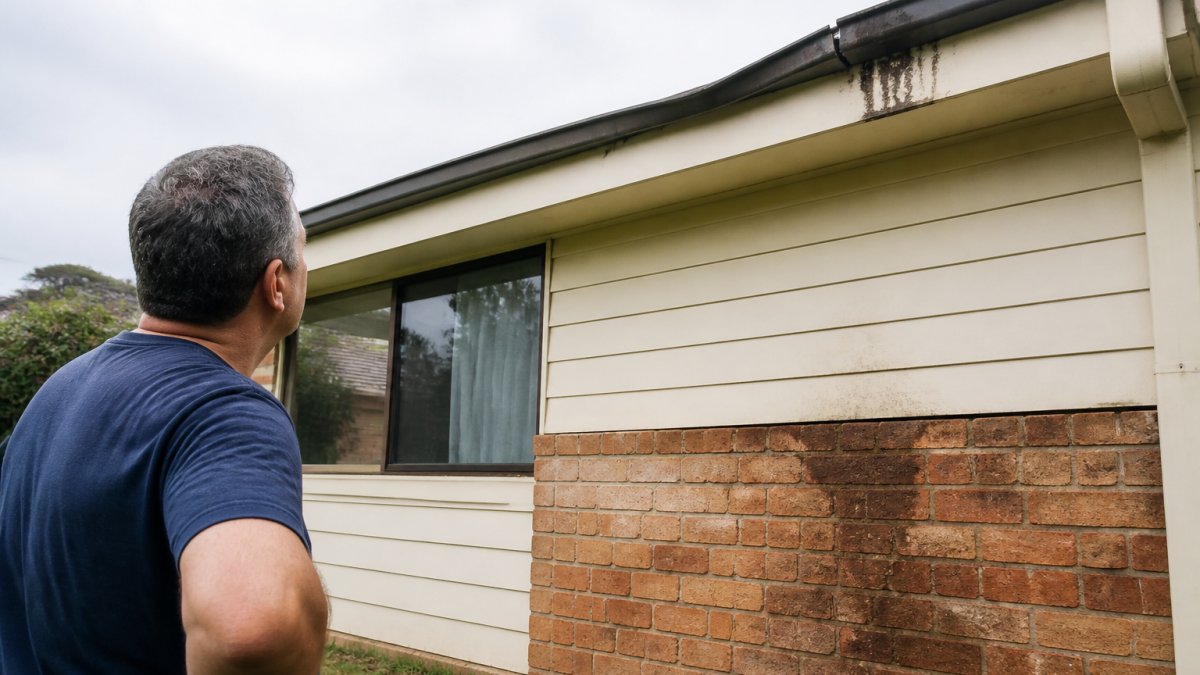
The clearest signs of gutter water damage are sagging channels, rust spots, paint peeling on the fascia, and water stains on ceilings or external walls.
What Each Warning Sign Is Telling You
- Sagging or dropped channels usually mean loose or failed hangers, or a run that has lost its fall. Water sits in the low point, and the weight accelerates the sag.
- Rust, cracks, holes and pin-hole drips are local failures. A pinhole leak drips onto the fascia continuously, so the timber stays wet long after the rain stops.
- Paint peeling or bubbling on the fascia is a moisture signal. Timber swells and pushes paint off when repeatedly wetted.
Check these every few months and after any major storm. Photograph anything you are unsure about so you can compare it next season.
Diagnosing Overflow Causes Beyond Debris
Overflow does not always mean a blockage, sometimes the system is undersized or badly pitched. If gutters are clear and still overflow, the fix is a repair or redesign, not another clean.
- Check the fall. Water should run toward the outlet along the whole run; a level or back-pitched run holds water in the middle and overflows at the low point no matter how clean it is. A spirit level in the channel, or watching where water sits after a flush, shows this quickly.
- Count outlets against roof area. A long run served by a single downpipe cannot keep up in heavy rain, so the channel fills and sheets over the edge. Adding an outlet or splitting the run is the fix.
- Check downpipe capacity and condition. Undersized, crushed or partially blocked downpipes back water up into the gutter. Flush from the top; if the outlet trickles, the restriction is in the pipe, often at a bend or the base.
- Look for failed joins and cracks. A cracked section or failed joint leaks before water reaches the outlet, so the downstream gutter looks fine while the wall gets wet. Seal small cracks with gutter sealant or silicone caulk, and replace failed end stops rather than patching them.
- Check hangers and brackets. Loose hangers let the run sag between fixings, creating new low points. Re-securing or replacing them restores the fall.
- Consider whether the system is undersized. Older homes and extensions sometimes have gutters and downpipes sized for a smaller roof area than they now serve; overflow in heavy rain is then a design limit, and the remedy is larger capacity, not more cleaning.
The symptoms above are consequences; the overflow causes are the mechanisms behind them. Fixing the mechanism is what actually prevents the damage from recurring.
Do Gutter Guards Prevent Water Damage?
Gutter guards reduce how often you clean, but they do not remove maintenance entirely. A guard is a debris-management tool, not a water-damage cure: it changes what gets into the channel, but does not fix slope, capacity or downpipe problems, and does not seal a leaking joint.
The Main Guard Types and What Each Actually Stops
Guards for domestic roofs generally fall into a few families, and each has trade-offs.
- Mesh and micro-mesh screens sit over the channel and keep out leaves, twigs and larger seed pods. Fine mesh stops more debris but can blind over with pollen, dust and fine grit, especially in windy, dry conditions. It needs brushing or hosing off periodically.
- Reverse-curve and brush guards rely on surface tension or bristles to deflect leaves while letting water through. They handle large leaves well but are less effective against small seed pods and fine sediment.
- Perforated or slotted covers are the coarsest option. They stop big leaves but let a lot of small material through, so the channel still silts up.
The finer the guard, the more often it needs a surface clean; the coarser the guard, the more often the channel itself needs clearing. There is no free option.
Matching a Guard to Your Roof and Tree Load
Guards earn their cost on properties with a heavy leaf load, large eucalypts, deciduous street trees, orchards or windbreaks. On a simple roof with few overhanging trees, the cleaning savings are smaller and a well-maintained open gutter can be the simpler choice.
Suitability also depends on roof pitch and gutter profile. Steep roofs shed debris faster and can make some guard types less necessary; shallow pitches and box gutters often need a different approach.
Guards Still Need Inspection and Cleaning
A common misconception is that a guard ends gutter maintenance.
Check guards when you would otherwise have cleaned the gutter, clear the surface, and flush the downpipes to confirm flow.
In general, guards are worth considering on properties with heavy leaf load, are less useful on a simple roof with few trees, and will not fix an existing alignment problem.
Downpipe Drainage and Keeping Water Away From the Foundation
Downpipe drainage is where most gutter systems quietly fail.
Fix the discharge end first:
- Extend downpipes so water lands well clear of the footing
- Direct flow onto a graded surface that slopes away from the house
- Use a spreader or soak pit where a straight run is not practical
Then check the gutters themselves for cracks and holes.
Gutter maintenance is not glamorous, which is why so many properties end up with rot, damp and foundation movement.
At Narrandera Gutter Cleaning, we clear gutters and downpipes with an industrial gutter vacuum system, flush and test water flow, and install premium aluminium mesh gutter guards.
Get started with Narrandera Gutter Cleaning and protect your home from water damage before the next storm. Request a free quote today.
Frequently Asked Questions
How do gutters prevent water damage?
Gutters collect roof runoff and channel it through downpipes away from the building. When they work properly, rainwater never touches the fascia, walls or foundation. When they fail, water pools against the base of the house, seeps into the slab or stumps, and can cause erosion, timber rot and damp inside the walls. A clear, well-aligned gutter system is the first line of defence against gutter water damage.
What causes gutters to overflow during heavy rain?
Overflow usually comes from one of four things: leaves and sediment blocking the channel, a clogged downpipe, a gutter that has pulled away from the roof edge and lost its fall, or a system too small for the roof area it drains. During heavy rain, even a partly blocked gutter backs up within minutes. Clearing debris and checking that water flows freely to the downpipe solves most overflow problems.
Do gutter guards prevent water damage?
Gutter guards reduce how much debris enters the channel, which cuts down on clogged gutters and the overflow that follows. They do not remove the need for maintenance. Fine sediment, small leaves and dust still settle on the mesh, and in the Riverina's red dust conditions that film can slow water flow. Guards help, but an annual inspection and flush still matters.
How far should downpipes direct water away from a building?
Downpipe drainage should carry water at least 1.5 to 2 metres away from the foundation, ideally onto a graded surface that slopes away from the house. A downpipe that discharges straight at the base of the wall concentrates rainwater in one spot and speeds up erosion and damp. Fit an extension or spreader and check the outlet after every big storm.