 How-to
How to Clean Bird Droppings Off Solar Panels Safely
Last Updated: November 21, 2026
Quick Summary
To clean bird droppings off solar panels safely, soak the dried droppings with warm water for a few minutes, then gently wipe them away with a soft brush or microfiber cloth. Never scrub a dry dropping, since that scratches the glass, and always switch off the inverter first.
- Work from the ground with a long-reach pole and low-pressure rinse where possible.
- Use distilled or demineralized water for the final rinse to avoid streaks and mineral residue.
- Pick a cool time of day, early morning or late afternoon, to avoid thermal shock.
- Dry the glass with a squeegee to prevent streaks and mineral residue.
- Call a professional when panels sit on a two-storey or steep roof.
Table of Contents
- Why Bird Droppings Matter for Solar Panel Output
- Safety First: Roof Access and Electrical Precautions
- What to Use to Clean Solar Panels: Tools and Water
- Step-by-Step: How to Remove Dried Bird Poop From Solar Panels
- Solar Panel Cleaning Mistakes to Avoid
- How Often to Clean Solar Panels With Bird Activity
- When to Call a Professional for Solar Panel Cleaning
- Request a Free Quote for Safe Panel Cleaning
- Frequently Asked Questions
Why Bird Droppings Matter for Solar Panel Output
Bird droppings block sunlight from reaching the solar cells beneath the glass, which is why you need to clean bird droppings promptly. A single large deposit can shade a whole panel section, and that shade drags down output more than most owners expect.
Solar panel performance is all about light hitting the solar glass evenly. Bird poop, dust, and pollen create soiling that scatters and absorbs light before it reaches the photovoltaic panels. Even a small patch of shade can cut the output of an entire solar array string.
Here is what matters most:
- Droppings are opaque, so they block light completely
- Dried droppings bake onto the panel surface and cling hard
- Bird activity clusters near trees, rooflines, and gutters
- Rain alone rarely shifts a stubborn deposit
If you want the full picture on how much a clean panel helps, read our guide on whether solar panel cleaning improves efficiency.
Safety First: Roof Access and Electrical Precautions
The biggest risk in this job is not the panels. It is the fall.
Roof access on a two-storey home is a genuine fall risk, and wet solar glass is slippery. Add live DC wiring and roof-mounted panels that stay energised in daylight, and the stakes climb fast.
Our rule: if you cannot reach a panel safely from the ground or a stable ladder, do not climb. Here is how we would approach it:
- Work from the ground with a long-reach pole and low-pressure rinse where possible
- Never stand on the panels themselves
- Keep water away from inverter boxes, cabling, and junction points
- Avoid cleaning in full midday sun so panels are not hot
- Wear non-slip footwear and gloves
For two-storey homes, safe roof work is its own skill. Our guide on how to clean two storey gutters safely covers the access basics that apply here too.
Watch out: spraying water into an exposed inverter or cable joint can cause damage or a shock. Switch off the inverter per the manufacturer's instructions before you start, and never work on wiring yourself.
What to Use to Clean Solar Panels: Tools and Water
Keep it simple and soft, but choose each item for a reason. The right kit for what to use to clean solar panels is a soft brush, a hose with a gentle nozzle, a squeegee, and a microfiber cloth. Nothing abrasive, nothing harsh.
Here is how the main tools compare, and when each earns its place:
- Garden hose with a low-pressure nozzle, the workhorse for the first rinse and for soaking. Use a shower or fan setting, never a jet. It shifts loose dust and pollen without forcing water past seals.
- Long-handled soft brush, for agitating softened droppings and reaching the middle of a ground-floor array. Choose a soft, flagged bristle made for vehicle or panel washing; stiff bristles and anything with exposed metal ferrules can scratch.
- Squeegee, for pulling water off the glass before it dries, which is the single best defence against streaks and mineral residue.
- Microfiber cloth, for gentle wiping around frames and for spot-treating a stubborn mark after soaking.
- Bucket of warm water, for soaking a cloth or brush, not for throwing over the array.
What to leave in the shed:
- Abrasive materials like scouring pads, steel wool, and gritty creams
- Harsh chemicals and strong detergent, which can leave residue and attack frame seals
- High-water pressure nozzles and pressure washers on full blast
A common mistake is reaching for a pressure washer on full blast. That water pressure can force water past seals and damage the solar glass, and on a tilted array it can also drive water into frame joints. Keep it low and gentle.
Watch out: if you use a ladder to reach a brush, treat the ladder as the primary hazard, not the panels, set it on firm level ground, keep it clear of gutters and wiring, and do not overreach. If the brush cannot reach the panel from a stable position, that panel is a job for a professional, not a longer pole.
Step-by-Step: How to Remove Dried Bird Poop From Solar Panels
To clean bird droppings, soaking beats scrubbing every time. The goal is to soften the dropping so it lifts away, not to grind it off.
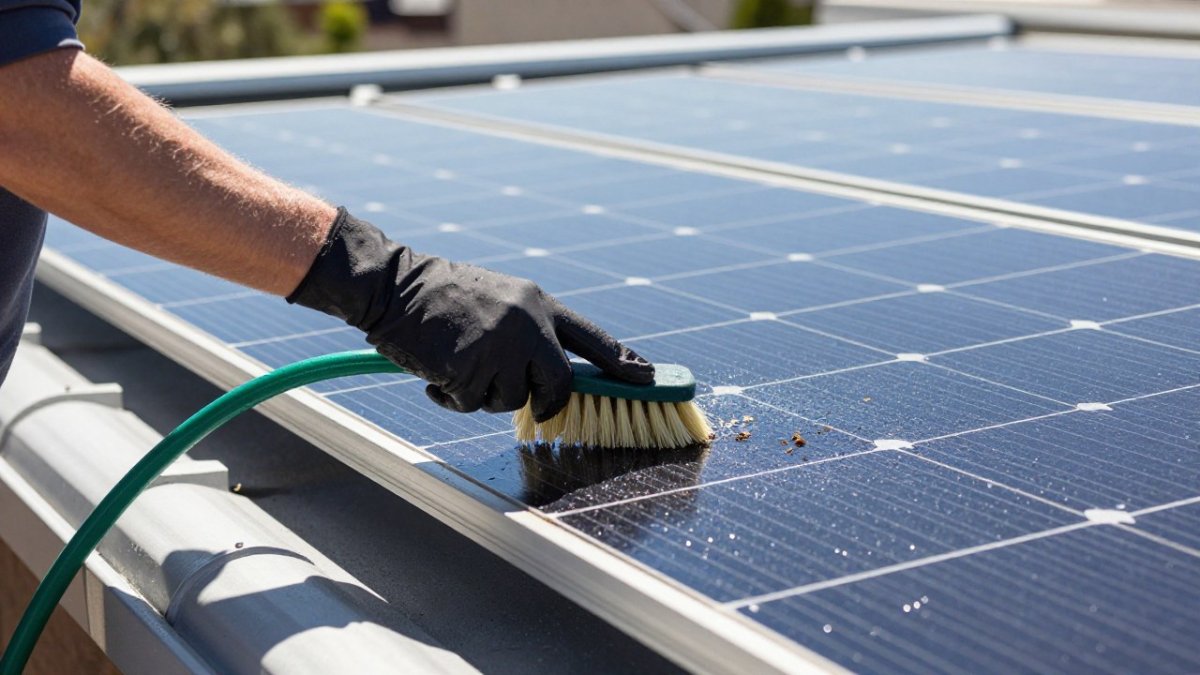
Here is our step-by-step method for how to remove dried bird poop from solar panels:
- Pick a cool time of day, early morning or late afternoon, to avoid thermal shock
- Switch off the inverter as the maker instructs
- Give the panel a low-pressure rinse to lift loose dust and pollen
- Soak the dried droppings with warm water and let them sit for a few minutes
- Gently wipe the softened mess with a soft brush or microfiber cloth
- Rinse again with clean water
- Dry with a squeegee to prevent streaks
Watch out: scrubbing a dry dropping scratches the glass and can leave a permanent mark. If it will not budge after soaking, soak it again. Patience protects the panel.
Soaking beats scrubbing, and this is the order we work in.
| Step | What to do |
|---|---|
| 1 | Pick a cool time of day, early morning or late afternoon |
| 2 | Switch off the inverter as the maker instructs |
| 3 | Give the panel a low-pressure rinse |
| 4 | Soak dried droppings with warm water for a few minutes |
| 5 | Gently wipe with a soft brush or microfiber cloth |
| 6 | Rinse again with clean water |
| 7 | Dry with a squeegee to prevent streaks |
Solar Panel Cleaning Mistakes to Avoid
Most damage we see comes from impatience, not bad tools. Here are the solar panel cleaning mistakes to avoid:
- Scrubbing dry droppings instead of soaking first
- Using abrasive materials that scratch the solar glass
- Blasting panels with high-water pressure
- Cleaning hot panels in full sun, risking thermal shock
- Letting tap water dry and leave mineral residue
- Standing on the panels or stepping between them
- Skipping the inverter shutdown
The pattern is clear. Rough handling and hard water cause most problems. Gentle wiping and soft water prevent them.
How Often to Clean Solar Panels With Bird Activity
There is no fixed calendar, but bird activity sets the pace. If bird droppings keep landing on your solar array, check the panels every few weeks and clean when soiling builds up.
For how often to clean solar panels, use these triggers:
- Visible droppings on more than a couple of panels
- A drop in energy production on your inverter monitoring app
- Heavy pollen, dust, or red dust after storms
- Nesting birds or trees overhanging the roof
Inverter monitoring is your best signal. If output slides on clear days, soiling is likely the cause. Clean, then compare. Quiet periods need less attention; heavy bird traffic needs more.
When to Call a Professional for Solar Panel Cleaning
Hire a pro when the roof is high, the mess is widespread, or safety is in doubt. Professional cleaning removes the fall risk and the electrical worry in one go. The useful question is not "can I reach it?" but "can I reach it safely, from a stable position, without touching wiring?"
- Can you see and reach every soiled panel from the ground with a long-reach pole, or from a stable ladder on firm level ground? If yes, ground cleaning is reasonable for light soiling.
- Is the roof steep, wet, mossy, or more than one storey, or are panels set back from the gutter? If yes, stop and book a professional. Wet solar glass on a pitched roof is a genuine fall risk, and a fall from height is far more costly than a clean.
- Is there any sign of damaged cabling, a cracked panel, a tripped inverter, or a fault code on the monitoring app? If yes, do not clean. Isolate the system per the manufacturer's instructions and call a qualified technician, water near damaged DC wiring is a shock risk, and DIY cleaning can void warranties.
- Are droppings widespread across the array, or baked on after weeks of heat? If yes, a professional soft-wash is faster and less likely to scratch glass through repeated scrubbing.
Call a professional when:
- Panels sit on a two-storey or steep roof, or access needs roof anchors and harnesses
- Droppings cover much of the solar array or have baked on hard
- You are unsure about shutting down the inverter or isolating the DC side
- You see damaged wiring, connectors, or junction boxes, or the inverter shows a fault
- You want a streak-free finish without the climb
Watch out: never work on wiring, connectors, or the inverter internals yourself, DC solar circuits stay energised in daylight, and only a licensed electrician should touch them. If in doubt, isolate and call.
We use soft-wash gear and low-pressure methods suited to local conditions. Wondering what it costs? Our breakdown of solar panel cleaning service pricing explains what drives the quote.
Request a Free Quote for Safe Panel Cleaning
Cleaning bird droppings off solar panels safely comes down to soft tools, soft water, and a healthy respect for heights and wiring. Get those right and your panels stay clean, clear, and catching light.
At Narrandera Gutter Cleaning, we handle solar panel washing with industrial-grade equipment and we are fully insured. We know local conditions across the Riverina, and we work safely at height so you do not have to. Our service is rated 5 stars by customers.
Get started with Narrandera Gutter Cleaning by requesting a free quote.
Frequently Asked Questions
Can bird droppings damage solar panels?
Bird droppings can cause more than temporary output loss. The acidic content can etch the solar glass and anti-reflective coating if left for weeks, and the buildup creates hot spots that stress individual cells. Regular cleaning and prompt removal of fresh droppings prevents permanent marking and keeps your array performing as designed.
Should you wet dried bird droppings before cleaning solar panels?
Yes. Dried droppings bond tightly to the glass, so soaking them with warm water for a few minutes softens the residue and lets you wipe it away without scrubbing. Use a low-pressure hose or a spray bottle, then follow with a soft brush or microfiber cloth. Never chip at dry droppings with a scraper, as this can scratch the panel surface.
Can you use a pressure washer on solar panels?
No. High-pressure water can force moisture past the panel seals, crack the glass, and damage the frame. A garden hose on low pressure or a soft-wash attachment is the safest option. If you need to remove stubborn soiling, soak the area and use a soft brush rather than increasing water pressure.
How often should solar panels be cleaned if birds keep leaving droppings?
Inspect your panels every few weeks and clean whenever droppings are visible, especially in areas with heavy bird activity. A full clean every three to six months is typical for most properties, but rural or tree-lined sites may need it more often. Monitoring your inverter output helps you spot soiling before it becomes a bigger problem.